
Back in 2021 and 2022, I was doing some English language tutoring as a volunteer with Powell River Immigrant Services. Things were going so well that I thought, “hmm… maybe I should put my name and email on a tutoring services list running out of the local university.” After all, it’s always good to have a side hustle!
A few months later, I finally got a bite, from a man named Alberto Romain. His message was short and to-the-point; he was looking for someone to tutor his child, and curious about rates.
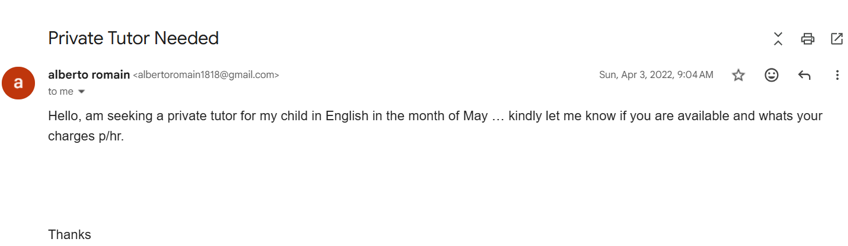
I replied with my interest and proposed rate, to which he happily agreed. At this point, it seemed pretty legitimate, though some of the wording did feel a little odd. And then it took a turn that made me go NOPE.
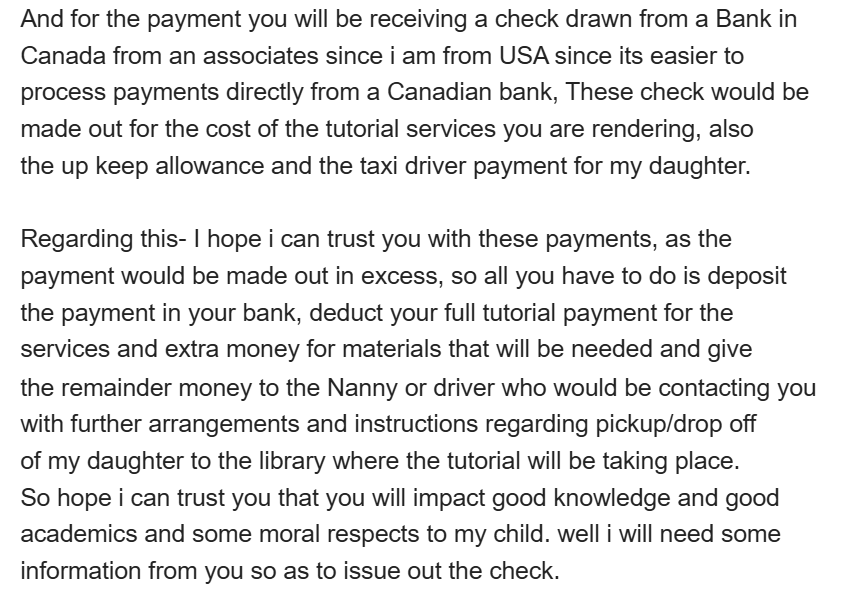
Okay, so, what is going on here?
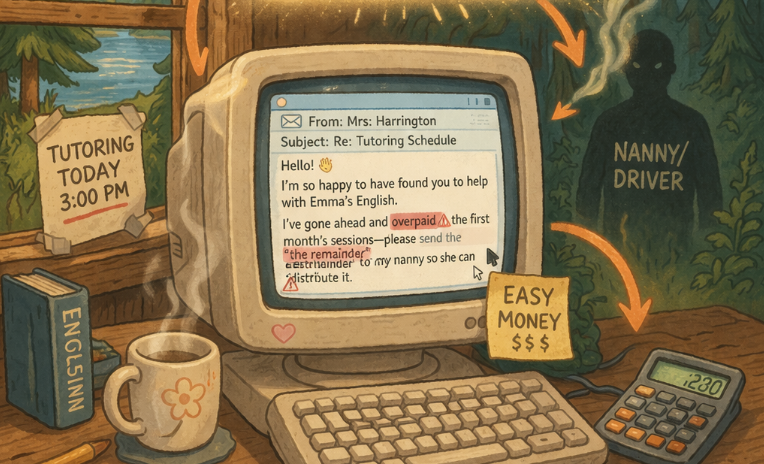
This is a classic overpayment scam dressed up as a tutoring job. The moment he says he’ll send a check for more than the agreed amount, covering not just your tutoring fee but also “upkeep” and a “taxi driver”, and asks you to forward the extra money to a third party, the red flags start waving hard. The setup relies on a common misconception: that once you deposit a check and the funds appear in your account, the money is real. It isn’t. Banks often make funds available before the check has actually cleared, and days (or even weeks) later, when the check is discovered to be fraudulent, the full amount is pulled back out of your account.
If you’ve already sent the “extra” money along to the supposed nanny or driver, that money is gone, and you’re the one on the hook. The scammer walks away clean, and you’re left covering the loss.
There are a few telltale signs all bundled together here:
- slightly off grammar and phrasing
- an overly agreeable client who doesn’t negotiate
- a convoluted payment arrangement involving third parties
- an urgency to move forward with payment
Legitimate clients don’t tend to ask tutors to act as middlemen for distributing funds, and they certainly don’t tend to send excess money and trust a stranger to pass it along.
In short, this was about getting me to deposit a fake check and send real money to someone else.
How did they get my email?
I gave them my email! Or rather, I gave it to the local university, who hosted it as a PDF that search engines then indexed and scammers scraped and contacted at scale. Everyone else on that tutoring list? Also hit with the same scam, and a few people got in quite a bit deeper than I did 😬
Even before AI, it was trivially easy for scammers to:
- Find PDFs, CSVs, and other documents at scale
- Filter them for tutoring-related signals, and
- Compose emails to thousands of targeted recipients
With AI, the barrier for entry to this type of scam is even lower.
It just goes to show that your email is a precious bit of personal information…
The saving grace: My friend fell for a similar scam when I was a teenager
Okay, so here’s where my friend’s historical misfortune turns into a bit of wisdom, which I hope to share with you all.
Back in my teenage years, when my friends cohort first started getting bank accounts, a good friend of mine confided in me that he had deposited a cheque for a down-and-out looking adult that was hanging around the bank.
The pretext of the scam was that because the stranger had bad credit history, the banks wouldn’t deposit his cheque, but if my friend were to be so kind as to deposit it, he would get $20 for his trouble. To a teenager, that’s easy money! Unfortunately, that easy cash was essentially from my friend to himself, with the rest of the cash withdrawn from the fake cheque never to be seen again, and the total to be withdrawn from his account.
Yes, dear readers, I’d seen this exact same pattern as a teenager in the suburbs, and eventually came to know the term “overpayment scam” later in life.
The thing is, once you know a pattern, you can see it anywhere, even when it’s far more sophisticated.
In essence, that’s what this website is all about: recognizing patterns that keep us more resilient and secure.
Thanks for reading,
–IW