
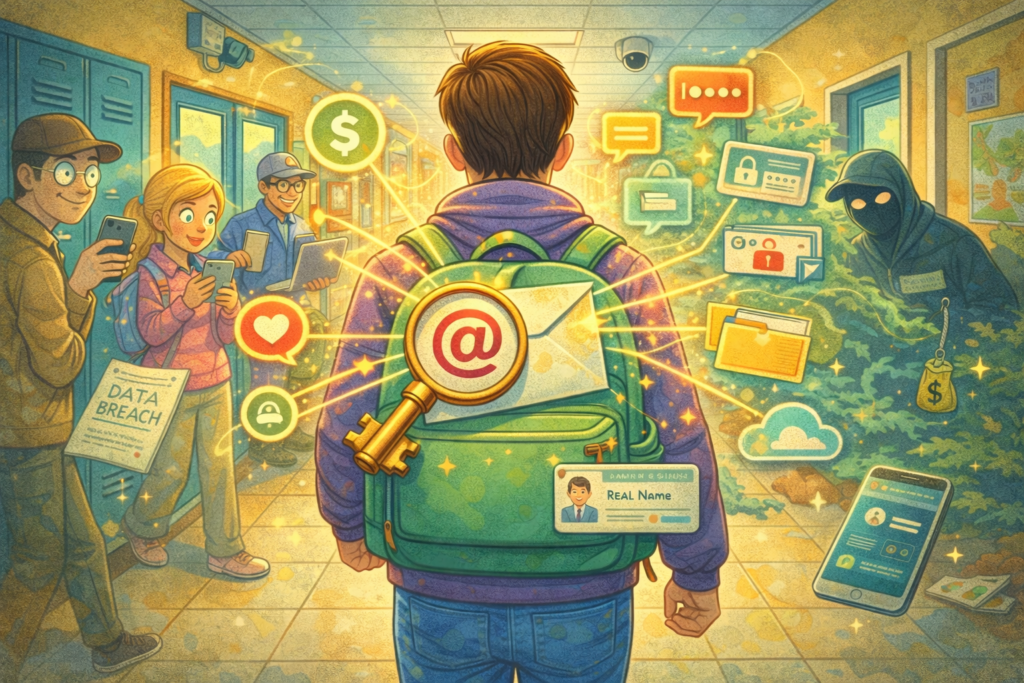
Your Email Address Is Not Just Contact Info
It’s easy to think of your email address as something trivial—just the place where messages land. You give it out to sign up for things, to receive receipts, to log into services.
But from a personal security perspective, your email address is one of the most stable identifiers tied to your digital life.
Names can be super common. Usernames can change, and require no ownership. Phone numbers get recycled. But email tends to follow you for years—sometimes decades—and across dozens (or hundreds) of services.
In a lot of systems, it’s not just contact info. It’s the primary key to your identity.
The Moment It’s Exposed, It Becomes a Pivot Point
Once your email address is out in the wild, it becomes a starting point.
With just an email address, someone can start checking where you have accounts. Password reset flows alone often reveal whether you’re registered somewhere. That’s enough to build a rough map of your digital footprint—banking platforms, social media, cloud services, random forums you forgot you ever joined.
From there, it expands.
Your email can show up in breach data. It can be tied to old passwords. It can be linked to usernames you’ve reused elsewhere. It can lead to your real name, your employer, your habits, your networks.
This isn’t hypothetical. This is standard operating procedure in cyber threat intelligence, fraud operations, and private investigations.
Why This Actually Matters
Most people don’t care that their email is “out there” until something happens.
Most people can recognize the obvious scams by now. But once your email has been enriched with context—where you work, what tools you use, what services you rely on—that changes. When your email exposes your online footprint, it’s easy for attackers to conduct effective and targeted social engineering attacks (phishing) that even the most critical-minded of us might fall for.
Instead of a Nigerian Prince scam, now the message looks like:
- A document shared with you on a platform you actually use
- A login alert from a service you recognize
- A request that appears to come from someone in your organization
At that point, it’s no longer about tricking “anyone.” It’s about targeting you.
And your email address is what made that targeting possible in the first place.
How Your Email Gets Out There (Even If You’re Careful)
Most people don’t leak their email in one obvious way. It’s more gradual than that.
You sign up for a service that gets breached years later. You post your email somewhere publicly without thinking about it. A mailing list gets scraped. A company you trusted sells or mishandles your data. Someone CCs you on a long thread that gets forwarded around.
Over time, your email propagates.
And once it’s out, you don’t control how it spreads.
Flip the Perspective
If you’ve ever done investigations, threat intelligence, or even basic OSINT work, you already know this. An email address is gold.
It’s one of the fastest ways to pivot into a broader picture of a person or an organization. It ties systems together. It reveals patterns. It opens doors.
That’s exactly why it needs to be treated with more care than most people give it.
What You Can Actually Do About It
This isn’t about disappearing from the internet. That’s not realistic.
It’s about reducing how easily everything connects back to a single point.
One of the simplest things you can do is stop using one email address for everything. Separate your digital life a bit—one for important accounts, one for sign-ups, one for public-facing use. That way, when one gets exposed (and it will), it doesn’t automatically expose everything else.
Aliasing helps too. Even something as simple as adding tags to your email (e.g. if you use gmail) can give you visibility into where your data is leaking from—and control over how you filter or shut things down later.
And maybe most importantly, be more intentional about where you share your primary email. Not paranoid—just deliberate.
Bottom Line
Your email address isn’t just where messages go. It’s how systems recognize you, how attackers find you, and how your digital identity gets stitched together across platforms.
You don’t need to hide it completely. But you also shouldn’t treat it like it’s common knowledge.