
Today I was eating some Beans and $H!T, and as I was warming up the beans, I started walking around my yard to see what I could put in there to increase the nutritional value of my easy meal.
Typically, when people think about foraging, they think of nature, forests, native species, etc. But I’ve long been an advocate of foraging-in-place whenever possible, with the usual caveats that you should watch out for dog pee, heavy metals, etc.
In the qathet region, which is on the west coast of Canada, April is a very easy time to forage on disturbed sites, such as yards and gardens. Here’s a list of a dozen or so plants I foraged in my own backyard, representing almost entirely weedy and disturbed-soil-loving species.
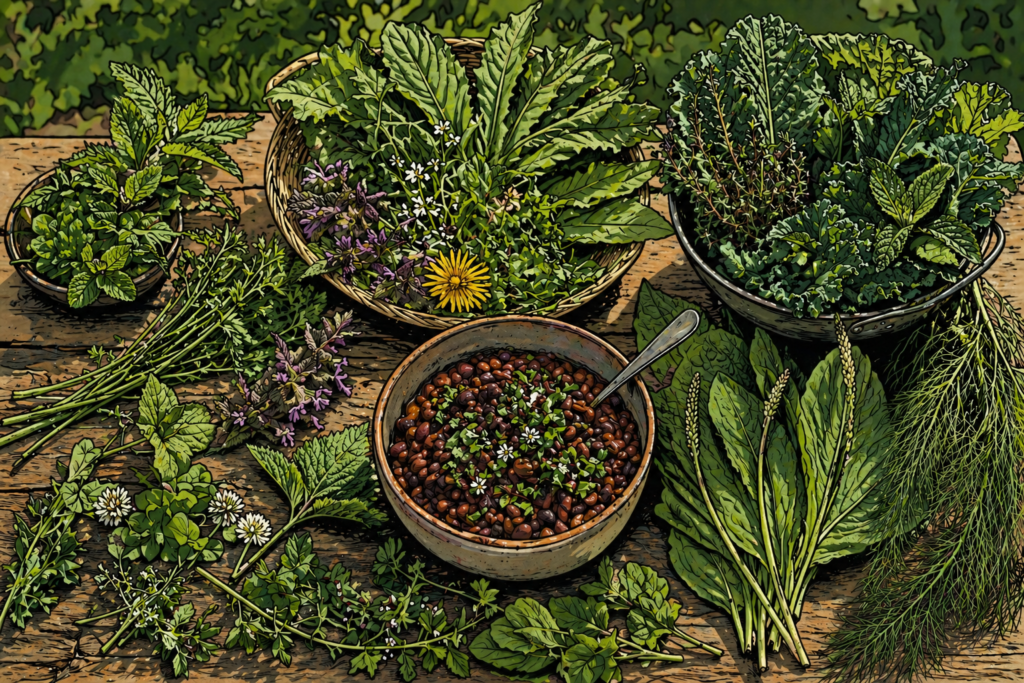
1. Dandelion (Taraxacum officinale)
A very common lawn and garden weed with edible leaves, flowers, and roots; young spring leaves are best before bitterness increases.
2. Common mallow (Malva neglecta)
Low-growing plant with round crinkled leaves and mild flavour; leaves and immature seed pods are edible and useful as a softening green.
3. Chickweed (Stellaria media)
Tender sprawling spring weed with tiny white star-like flowers; mild, juicy, and excellent raw in salads or sandwiches.
4. Purple deadnettle (Lamium purpureum)
Mint-family weed with purple-tinted upper leaves and small tubular flowers; edible tops have a mild herbal flavour and no sting.
5. Broadleaf plantain (Plantago major)
Flat rosette plant with broad leaves and strong parallel veins; young leaves are edible, while older leaves become fibrous.
6. Fennel greens (Foeniculum vulgare)
Feathery aromatic foliage from escaped or self-seeded fennel; fronds have a sweet anise flavour and are excellent as an herb.
7. Bitter dock (Rumex obtusifolius)
Dock species with wavy-edged leaves; young leaves can be eaten cooked in moderation due to oxalic acid content.
8. Sheep sorrel (Rumex acetosella)
Small sorrel with narrow arrow-shaped leaves and a bright lemony taste; often used sparingly as a tart accent green.
9. White clover (Trifolium repens)
Common lawn clover with trifoliate leaves and white flower heads; leaves and flowers are edible, best used young or dried for tea.
And all the rest…
I also added a handful of plants that I’ve intentionally brought onto my property but have self-seeded or otherwise self-propagated; these include Mint (Mentha spp.), Thyme (Thymus vulgaris), Nettles (Urtica dioica), Kale (Brassica oleracea), and Parsley (Petroselinum crispum).
The verdict? Another excellent meal of Beans and $H!T