
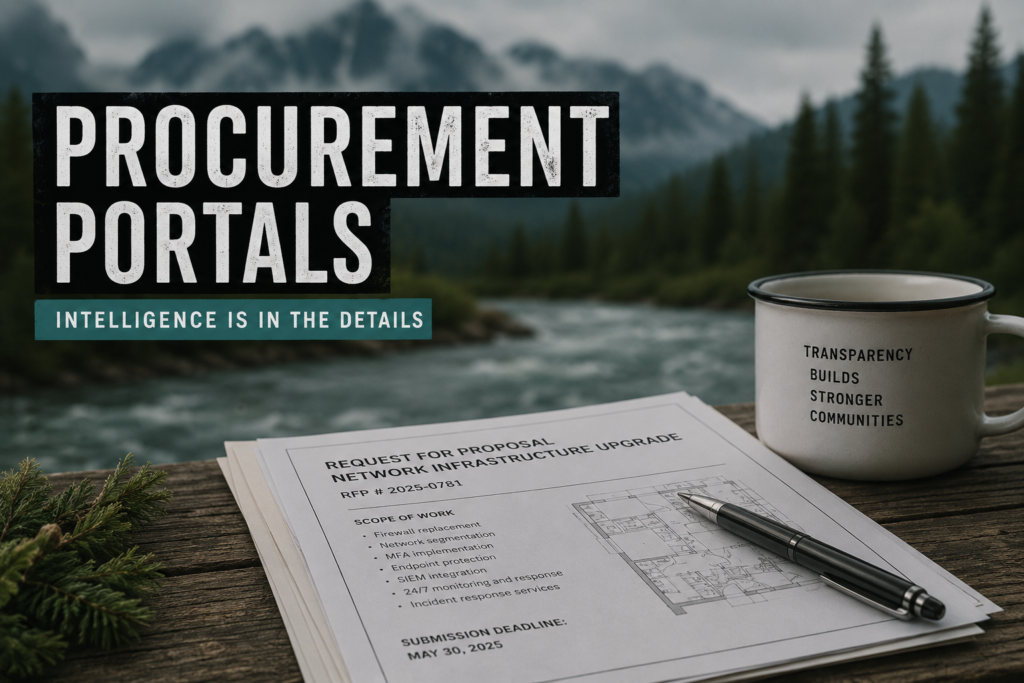
Procurement portals are one of the best structured OSINT resources available online. They combine operational detail, historical visibility, technical context, vendor relationships, infrastructure planning, and budgetary information into searchable public records.
If you’re looking to grow your business, understand your industry, conduct research, monitor infrastructure development, or simply better understand how organizations and communities function, procurement portals can be incredibly valuable.
For researchers, journalists, and OSINT practitioners, procurement records provide structured insight into how organizations actually operate. A single procurement notice may reveal infrastructure upgrades, software platforms, transportation initiatives, emergency management priorities, telecommunications projects, cybersecurity modernization efforts, or operational challenges that would otherwise receive little public attention.
Procurement data is also valuable from a civic awareness perspective. Local government decisions can often feel abstract or difficult to follow until construction begins, roads close, or new infrastructure suddenly appears. Procurement records help fill in that gap.
Below is a large curated list of procurement systems across British Columbia, Canada, North America, and internationally. Some are centralized government portals, while others are procurement aggregators, municipal systems, or sector-specific platforms.
British Columbia Procurement Portals
BC Bid is the primary Government of British Columbia procurement portal and one of the most useful starting points for regional infrastructure and cybersecurity research. It regularly contains notices relating to utilities, healthcare, transportation, emergency services, municipal infrastructure, and technology modernization projects.
Municipal & Regional Platforms Commonly Used Across BC
Many BC municipalities rely on shared procurement ecosystems such as bids&tenders, Bonfire Interactive, or CivicInfo BC. Some also have their own procurement pages, as do large organizations like transit companies, schools, and healthcare organizations.
Canada-Wide Procurement Portals
Federal Government
CanadaBuys is the primary federal procurement portal operated by Public Services and Procurement Canada. It is extremely valuable for researching federal cybersecurity initiatives, cloud migration projects, infrastructure modernization, defence-adjacent procurement, and large-scale technology deployments.
The Government of Canada Contract Disclosure historical database provides visibility into federal contract awards and vendor relationships over time, making it useful for historical procurement research, due diligence, and ecosystem mapping.
MERX is one of the largest procurement aggregators in Canada and includes federal, provincial, municipal, utility, and institutional tenders from across the country.
bidsCanada aggregates procurement notices and bid opportunities from multiple jurisdictions across Canada.
FindRFP focuses on aggregating North American government procurement opportunities and can be useful for broader infrastructure and vendor trend analysis.
Provincial Procurement Portals
Other major Canadian provincial procurement systems include:
- Alberta Purchasing Connection
- SaskTenders
- Manitoba Tenders
- Ontario Tenders Portal
- Quebec SEAO
- New Brunswick Opportunities Network
- Nova Scotia Procurement
- Newfoundland and Labrador Procurement
United States Procurement Portals
Federal
SAM.gov is the primary US federal procurement portal and one of the most important procurement OSINT resources globally. It provides visibility into federal infrastructure, cybersecurity, cloud, telecommunications, and defence-adjacent contracting activity at enormous scale.
State-Level Systems
Major US state procurement systems include:
- California eProcure
- Texas Electronic State Business Daily
- New York State Contract Reporter
- Pennsylvania eMarketplace
- Florida MyFloridaMarketPlace
- Illinois BidBuy
Many US cities and counties also rely on shared procurement ecosystems such as Bonfire, bids&tenders, PlanetBids, OpenGov Procurement, IonWave, and BidNet Direct.
International Procurement Portals
European Union
TED (Tenders Electronic Daily) is the primary EU-wide procurement system and one of the largest public procurement databases in the world. It provides substantial visibility into infrastructure, energy, telecommunications, transportation, cybersecurity, and government modernization projects across Europe.
United Kingdom
Useful UK procurement systems include:
Australia & New Zealand
Asia-Pacific
Useful Asia-Pacific procurement systems include:
Latin America
Major Latin American procurement systems include:
Ukraine
Prozorro is widely studied internationally as a transparency-focused procurement platform with extensive analytics and public oversight functionality. It is frequently referenced in discussions around open government and procurement transparency.
Procurement Aggregators and Meta-Sources
If you want broad visibility across multiple jurisdictions, procurement aggregators can be extremely useful.
OpenOpps Procurement Sources maintains one of the largest publicly accessible indexes of procurement portals globally.
Additional aggregation platforms include:
Finding More Portals
Even basic search queries across web search engines like Google can uncover surprisingly detailed operational information. Dorking techniques such as "RFP" cybersecurity, "network upgrade" filetype:pdf, "SCADA modernization", or "SOC-as-a-Service" can quickly reveal technical environments, infrastructure projects, and organizational priorities.
Municipal procurement pages are also worth watching closely, especially in smaller regions where local governments may publish highly specific operational details directly on their websites, with no portal to speak of.
Why Is The Procurement Process So Underrated As A Source of Information?
When people think about valuable OSINT sources, procurement portals are usually not the first thing that comes to mind. That’s fair… They’re not as exciting as data breaches, leaked chats, or exposed documents. Most of the time, they look bureaucratic and mundane: PDFs, spreadsheets, bid notices, vendor contracts, and technical requirements.
But procurement systems are often one of the clearest and most structured windows into how organizations actually operate.
Governments, municipalities, healthcare systems, school districts, utilities, and large organizations routinely publish operational details because vendors need to understand what is being purchased, replaced, upgraded, or fixed. And unlike many other forms of OSINT, this information is intentionally public and often archived for years.
Let’s take a look at some of the ways procurement portals can be useful, interesting, or operationally significant, from different operational perspectives.
From a Cybersecurity Perspective
Organizations are often far more candid in procurement documents than they are in polished public-facing material. As a result, procurement portals can provide cybersecurity professionals (and potentially threat actors) with an unusually honest look at organizational environments.
A cybersecurity tender might openly reference legacy infrastructure, upcoming projects and upgrades, detection software, or even ongoing operational challenges, such as staffing shortages. In some cases, procurement documents effectively become maps of an organization’s technology stack and broader infrastructure environment.
Procurement records can also provide valuable historical visibility. Over time, they may reveal changes in security maturity, infrastructure modernization, vendor relationships (i.e. supply chain vulnerabilities), or even shifts in the broader threat landscape itself.
From an Investigative Perspective
Procurement records are also extremely useful for investigations, due diligence, and broader ecosystem mapping. Contracts and bid awards can help identify vendor relationships, technological dependencies, infrastructure patterns, operational priorities, and timelines of organizational change.
Because procurement data is usually public, structured, and archived, it can also be an excellent pivot point for further OSINT research. A single tender may reveal the names of contractors, MSPs, cloud providers, software platforms, physical locations, project contacts, or internal terminology that can then be correlated with other public information sources.
Over time, repeated procurement activity can reveal which organizations rely heavily on the same vendors or service providers. That matters because shared dependencies can create shared operational or cybersecurity risk across entire sectors or regions.
Procurement history may also reveal signs of operational stress or rapid change. Emergency infrastructure spending, rushed modernization projects, disaster recovery procurements, or sudden cybersecurity investments can sometimes provide indirect clues about larger organizational problems or incidents. Even when an organization never publicly discloses an issue, procurement activity occasionally tells part of the story anyway.
From a Civic Engagement Perspective
For many people, local government can feel opaque. Procurement records help fill in that gap by showing what organizations are planning, upgrading, purchasing, or prioritizing before many of those changes become visible day-to-day.
A municipality may quietly publish notices relating to water infrastructure upgrades, emergency communications systems, internet connectivity projects, CCTV expansion, fleet modernization, or public safety technology deployments. In many cases, these postings provide far more operational detail than press releases or social media updates.
This is especially relevant in smaller towns and rural regions where infrastructure decisions directly shape everyday life, resilience, emergency response capability, and economic development.
For community members, journalists, researchers, and local businesses, procurement portals can provide a much clearer understanding of where public resources are being directed and how communities evolve over time.
Procurement Data Is Excellent for Historical Research
One of the biggest advantages of procurement OSINT is that it is often preserved long-term. Many procurement systems maintain searchable archives going back years, allowing researchers to reconstruct infrastructure evolution, vendor transitions, technology adoption, and organizational maturity over time.
Organizations often forget that operational history accumulates online in the same way technical exposure does.
Procurement Portals Reward Curiosity
Another reason that procurement portals are so useful is that they reward patient, detail-oriented research. Interesting findings rarely come from a single dramatic document. Instead, useful insight emerges through aggregation: comparing multiple tenders, tracking recurring vendors, watching spending trends, correlating timelines, and combining procurement data with other forms of OSINT.
This is very similar to broader investigative work. Small details accumulate into operational understanding.
And because procurement data is usually structured, searchable, and public, it is often easier to analyze systematically than many other OSINT sources. Combined with infrastructure analysis, archived web content, social media, and local knowledge, procurement data becomes an extremely powerful source of operational understanding.
And importantly, this is not just relevant to cybersecurity professionals. Procurement portals matter because they reveal how organizations function in the real world: what they prioritize, what they struggle with, what they depend on, and where they are heading next.
Cover Your Assets – Procurement Portals In Exposure Assessments
Procurement portals can also be useful from an exposure assessment perspective. Organizations often focus on whether sensitive information is technically “public,” but not necessarily on how much operational context can accumulate across years of procurement records, attached documents, vendor references, infrastructure descriptions, and archived files. Reviewing your own organization’s procurement footprint can help identify unnecessary detail relating to internal systems, physical infrastructure, project timelines, staffing structures, metadata exposure, or vendor dependencies. In many cases, no single document is especially sensitive on its own; the real issue is how searchable, indexable, and aggregatable that information becomes once combined with other publicly available sources. You may not always be able to remove this information, but having an awareness of what’s out there will always be key in identifying and defending against phishing and other social engineering attacks.
In Closing
Hopefully, after this article you can see how public procurement portals really are an excellent source of information.
But like any public information source, procurement data can also create unintended exposure. That is why organizations should be intentional and deliberate about which details to include in procurement documents, attached files, and supporting materials.
As with many areas of cybersecurity and public transparency, the goal is not to remove all information about your organization from the internet, but rather finding a practical balance between transparency, operational effectiveness, and ongoing risk management. Just something to think about.
Another thing that I’ve noticed, over the years of helping private-sector companies join different procurement portals, is that there is no shortage of companies that will charge you big money to get you onto these portals. Meanwhile, the process is generally spelled out for you and just requires some focus and the ability to provide exactly what they’re asking.
With all of that in mind, I thank you for reading this article, and wishing you luck in all your endeavours, whether they be risk management, research, business growth, or civic engagement.
Knowledge is power, and procurement portals can be formidable partners in that sense.
As always, thanks for reading,
–Ionatan Waisgluss, Applied Awareness