
If you’ve bought groceries lately, you don’t need a report to tell you something is off. Prices are up, portions are down, and everything seems to taste worse. 😬
Most days, we feel like we’re splurging just by purchasing out basic staples, even when we buy them on discount. And in this high-inflation context, the last thing we need is to be out even more money due to misleading pricing. Of course, pricing discrepancies can happen in all sorts of ways, but in today’s article, we’ll be looking specifically at what we can do when a shelf tag that says one thing, and the cash register says another. Specifically, we’ll be looking at the Scanner Code of Practice in Canada and how it supports us in keeping our costs down and standing up for our rights as consumers.
What Is the Scanner Code of Practice (SCOP)?
The Scanner Code of Practice (SCOP), aka the Scanner Price Accuracy Voluntary Code, is a completely voluntary program that retailers can sign onto. It’s a way that retailers can embody ethical business practices by committing to accurate pricing, and that businesses can say “yes, we care about you.”
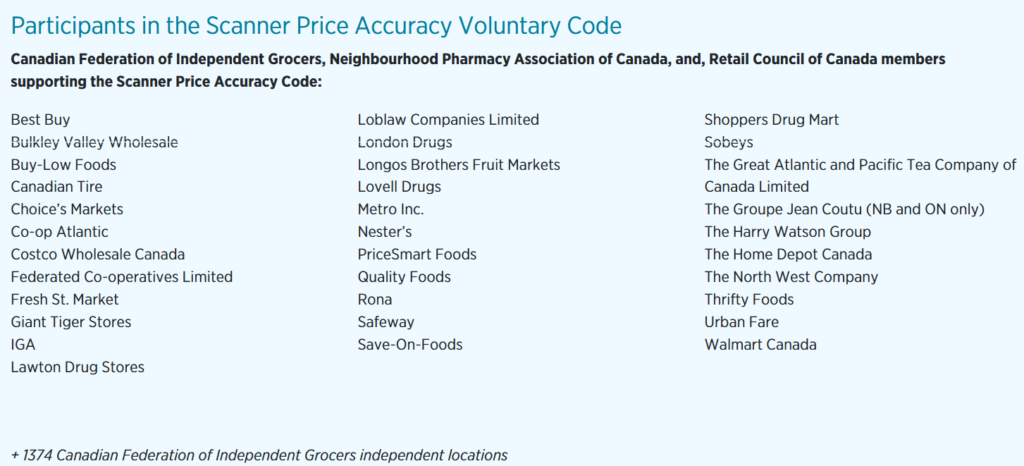
According to the Retail Council of Canada, there are approximately 1400 retailer brands that have signed onto this agreement. Here’s a screenshot from their website. NOTE: I haven’t been able to find the full list myself, but if somebody knows where it is, please email me!
When in doubt, you can always ask at the customer service desk: does your company subscribe to the Scanner Price Accuracy Voluntary Code (aka Scanner Code of Practice)? All retailers should know about it, even if they don’t follow it. And if they don’t follow it, a good question for them is “Why not? Don’t you think that consumers have the right to accurate pricing?” If you’re open to having those crucial conversations without being a total Karen, the retail world is your accurately-priced oyster! 🙏
So, what does the Scanner Code of Practice (SCOP) actually mean?
The premise is simple. If an item scans at a higher price than what was displayed on the shelf, there is a standardized correction. If the correct price is $10 or less, the item is free. If it’s over $10, you receive $10 off.
This is not consumer protection law. You cannot send the retailer for jail for not honouring it 🙄… No regulator is forcing retailers to adopt it. Like I said, participation in the Scanner Code of Practice is completely voluntary. When a retailer signs onto SCOP, they are choosing to say: we stand behind our pricing systems, and if we get it wrong, we will correct it in a consistent and transparent customer-facing way.
So when you invoke the code, you’re not asking for an exception or for something free. You’re holding a business to a commitment it made willingly.
Why SCOP Matters More as Food Prices Rise

As food prices rise, pricing accuracy stops being a technical issue and becomes an ethical one. Modern retail pricing is complex. Systems update frequently. Promotions overlap. Labels don’t always get changed in time. Staff turnover affects consistency. Errors are inevitable.
But the outcome for the customer is straightforward. If something scans higher than advertised, you are paying more than you were told you would… And you’ve made your shopping decisions based on the pricing information that was available to you!
The gap between expectation and reality (i.e. between what was displayed on the shelf and what was charged at the till) is where trust breaks down. The discrepancy hurts our wallets and it hurts our front-line decision-making process in the modern battlefield known as the supermarket.
The Scanner Code doesn’t eliminate errors, but it introduces a consequence for them. Not punitive, but corrective. It creates friction around inaccuracy, which is exactly what you want in a system where precision matters.
Why Consumers Hesitate to Use It
Even when people know about SCOP, they often don’t use it.
The hesitation is familiar. It feels minor. It feels awkward. The cashier didn’t cause the issue. The store is busy. It’s easier to let it go.
But that hesitation has a cumulative effect. Every time a discrepancy goes unchallenged, accuracy isn’t being enforced. Over time, that normalizes small errors. And in aggregate, small errors work out to hundreds of millions of dollars* for retailers in essentially hidden extra costs being passed on to consumers.
Why You Shouldn’t Feel Bad for Calling It Out
Using the Scanner Code of Practice isn’t meant to be confrontational. It’s not taking advantage of a system and it’s not about getting something for free. It’s about accountability.
You are reinforcing a baseline expectation: the price displayed should match the price charged. That’s not an aggressive position. It’s the minimum standard for fair commerce.
More importantly, you are participating in a system that depends on being used. If no one ever invokes the code, it becomes symbolic instead of functional.
And there’s a broader effect that often goes unspoken. When customers consistently point out pricing discrepancies and apply the code…
- Shelf labels get corrected faster
- Pricing systems are audited more closely
- Staff awareness improves
- Repeated errors are identified and fixed
This a form of decentralized accountability. It doesn’t rely on inspections or enforcement bodies. It relies on customers noticing and acting. In fact, you can think of calling on the SCOP as a service that you are providing free-of-charge to retailers: You are helping them maintain their price accuracy, and they’re not even your employer!
In that sense, invoking SCOP is not just self-interested—though in theory it could save you hundreds of dollars throughout your life. It benefits the general public by contributing to overall pricing integrity in the store. It makes the system better for the next person.
What the Scanner Code of Practice Doesn’t Cover
The Scanner Code of Practice is not a perfect tool, and it’s important to understand its limits. It generally doesn’t apply to:
- Clearance items
- Individually priced items (like clothing with tags)
- Some produce or weight-based goods
- Online purchases or delivery platforms
- Situations where items are clearly misplaced or mislabeled by customers
- And possibly other scenarios
But in a retail environment where prices feel increasingly volatile and opaque, the Scanner Code of Practice is one of the few immediate, practical tools available to consumers.
It won’t fix systemic pricing issues. It won’t stop inflation. But it does something important: It compares what is advertised to what is actually being charged.
So the next time something scans higher than the shelf price, pause and ask if the business follows the Scanning Code of Practice. Not to make a scene, and not to get a deal, but to uphold a standard that retailers themselves chose to adopt as a commitment to their customers.
Or if possible, go shop somewhere else that will honour this code and the rights of its customers to fair and transparent pricing.
Thanks for reading!
If this helped, share it with someone who’d benefit.
—IW, Applied Awareness
* No idea the actual number, but would love to find out!