
What Is a Trip Plan?
A trip plan is simply information you leave behind before heading outdoors. It tells somebody where you’re going, when you expect to return, and what to do if you don’t check back in. That’s it 🤷
It does not need to be complicated, and for most outdoor activities, even a simple text message is far better than nothing.
Whether you’re hiking, paddling, camping, driving forestry service roads, snowshoeing, or heading into the backcountry, trip plans are one of the easiest ways to improve your safety outdoors.
Why Trip Plans Matter
A lot of outdoor emergencies begin with very normal problems. Someone twists an ankle. A vehicle gets stuck. A trail junction gets missed. Weather changes faster than expected. A phone dies. Darkness arrives sooner than planned.
In many cases, the biggest challenge for rescuers is not necessarily the terrain itself, but simply figuring out where to start looking. A trip plan reduces uncertainty. It gives responders a starting point, a timeline, and a likely route.
What Should a Trip Plan Include?
A good trip plan usually includes:
- where you’re going
- your planned route
- departure and return times
- vehicle description and license plate
- who is with you
- emergency contact information
- instructions for what to do if you do not return
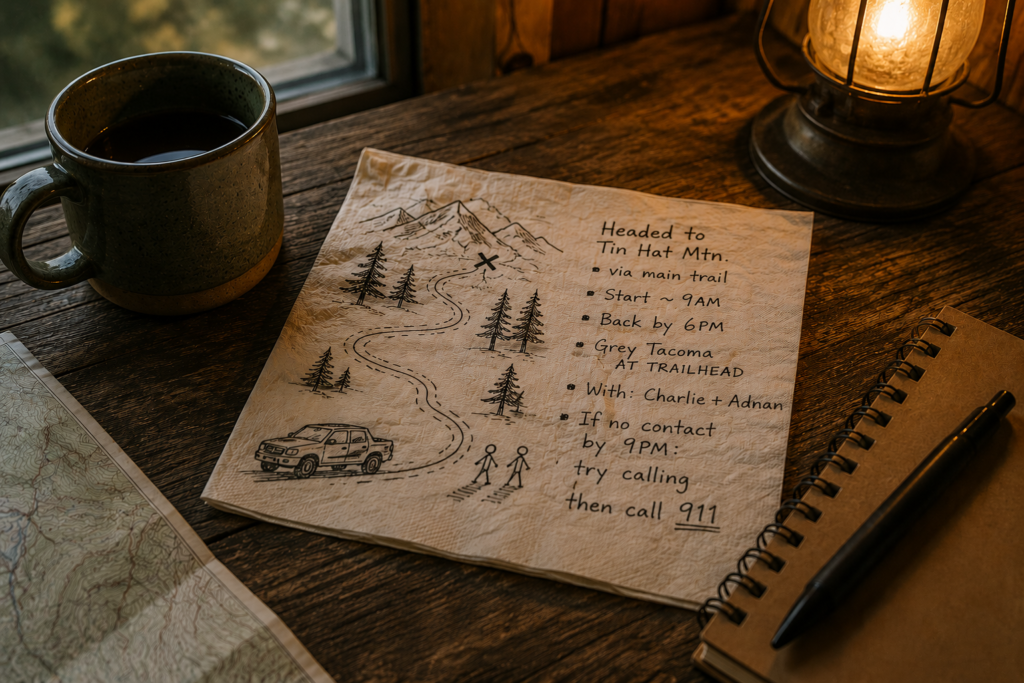
Even something very simple can help enormously, like a text or hand-written note to a trusted individual (or various) that says…
- Heading to Tin Hat Mountain via the main trail. Starting around 9 AM and expecting to return by 6 PM. Grey Tacoma parked at trailhead. If you haven’t heard from me by 9 PM, try calling first, then contact 911.
In British Columbia, Call 911 — Not SAR Directly
This is an important point. In BC, when someone is overdue outdoors or believed to be in danger in British Columbia, call 911. Dispatch coordinates with the appropriate emergency services, including Search and Rescue when needed. You do not need to find a SAR team or track down their number yourself. This is true even with Powell River SAR.
Do you find the idea of coming up with a trip plan from scratch kind of daunting? No worries, these resources have you covered!
AdventureSmart offers probably the best all-around Canadian trip-planning resource. Their tools are designed around the information Search and Rescue teams actually need during a response. Check out their trip tips, interactive online trip planner, or (simplest!) the AdventureSmart Printable Trip Plan PDF.
The Sea Kayak Association of BC also has their own printable trip plan (aka float plan), as does Jericho Beach Kayak, though these are obviously more focused on paddlesports.
Or make your own template and use it as needed!
Keep It Simple
For most trips, a good safety baseline is surprisingly straightforward:
- Tell somebody where you’re going
- Share a map or route screenshot
- Download offline maps
- Leave a realistic return time
- Know your limit, play within it
- Pack your kit for worst-case scenario
- Etc… (I can’t cover it all here)
Here’s what it boils down to. Trip plans are simple, free, and extremely effective. They are also one of the easiest outdoor safety habits to build into your routine.
So pick someone you trust… and let them know where you’re going! Or offer to be someone else’s trip contact!
Stay safe out there! 😀
–Ionatan Waisgluss, Applied Awareness