
For years, I’ve been harvesting Stinging Nettles (Urtica dioica) on the west coast.
I blanch them (quickly boil and then ice bath), squeeze them into a ball, and freeze them on a tray. Super simple, and if I harvest enough in one session or two, I can stock the freezer to get me through to next spring.
I use them in smoothies, curries, stir-fry, pasta dishes, palak paneer, frittatas, you name it! I even save the juice I squeeze out, and either drink it or freeze it.
Nettles are rich in vitamins (A, C, K), minerals (calcium, iron, magnesium), antioxidants, protein, and fibre! But don’t take my word for it; check out this pharmalogical study or look up nettles in some of the wild foraging resources on this website. And yet, most people don’t harvest them, or eat them, even where they grow in abundance!
When we talk about food security, one aspect we can easily address is the development of skills and familiarity with the local flora, i.e. learning what to eat and how… It doesn’t cost anything, and it’s an excellent hobby to pursue, provided you can do it safely and responsibly.
Many people I talk to are actually familiar with Stinging Nettles already, but didn’t know you could eat them… or they’ve heard you can eat them, but just never got around to trying them. What are you waiting for? Groceries are not getting any cheaper!

How to identify Stinging Nettles
Okay, first of all… make sure you’ve read our Terms of Use and Safe Harvesting Tips… Now you can keep reading 🔎
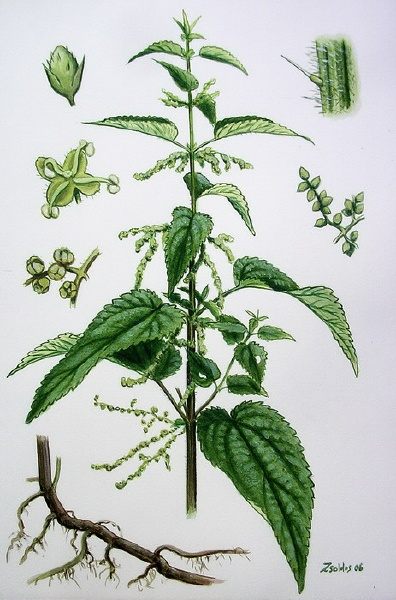
Stinging Nettle typically shows up in the spring late March to early April on the west coast, but later in other regions). At maturity, it is 0.5–2 meters tall, with a distinctly square stem, leaves occuring in opposite pairs (decussate/distichous appearance) along the stem, each leaf being elongated, sharply serrated, and pointed at the tip. Both the stems and leaves are covered in fine, translucent stinging hairs (trichomes), which give it its sting. You’ll often find nettles forming dense patches in nutrient-rich, disturbed soils (edges of trails, riverbanks, old homesteads). In flowering season, look for small, drooping clusters of greenish flowers emerging from the leaf axils.
Image: Wikimedia

Be aware that Stinging Nettle has several lookalikes—such as Dead-nettle and Wood Nettle—and because nettles occur worldwide, it’s not possible to cover every similar species, so identification should always rely on confirming the full set of characteristics rather than appearance alone. Always get an expert confirmation, rather than saying “yup, I’m pretty sure!”
How to harvest Stinging Nettles
When harvesting Stinging Nettle, the key is minimizing contact with the stinging hairs while taking only the tender upper growth. Wear gloves and long sleeves, then target the top 10–15 cm of the plant, where the leaves are youngest and most palatable. A serrated knife works especially well, as it grips the fibrous stem and makes a quick, clean cut without needing much pressure.
I’ve tried all sorts of other methods, but none compares in my opinon to selecting a handful of plants with one hand, harvesting them with a serrated knife, and quickly removing any foreign material (e.g. grasses, catkins, last year’s dead stems) before placing them in a basket without ever compressing them. Keep them out of the sunlight and let them breathe, and process them that same day if possible.
What about the stinging hairs!?
The sting from Stinging Nettle comes from tiny hollow hairs (trichomes) that act like microscopic needles, injecting irritants when they break against your skin. The good news is that they’re fragile—heat, drying, or crushing neutralizes them completely. Once the leaves are cooked (even briefly blanched), dried for tea, or thoroughly mashed, they lose their ability to sting. Until then, handle with gloves and avoid brushing against the plant; the underside of the leaves and stems tends to have the highest concentration of hairs.